
Arsalan Kharazmi has died at 82
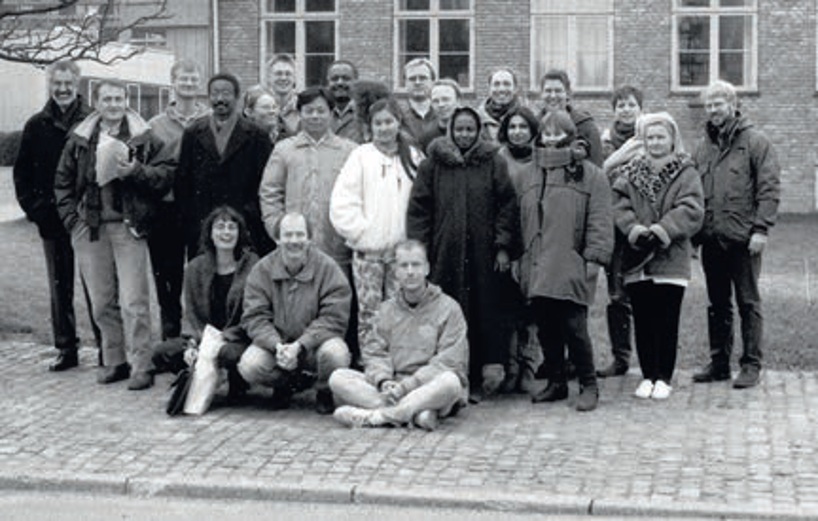
It with great sadness that we have to convey that our friend and colleague Arsalan Kharazmi passed away last week. Ami as we always called him had been suffering from cancer for some time.
Most current CMP members have never met Ami, but he was one of the founding fathers of CMP, and he played a major role for where we are today.
Ami was born in Iran in 1944. His family (who had a Turkish dialect as their mother tongue) owned a walnut farm in the mountains in southeastern Iran. In the 1970s he obtained a scholarship for University of California (Davis) and obtained his PhD degree in 1974. He also met Birgitte, and they married and settled in Shiraz, Iran, where Ami became Professor.
Life was good in Shiraz; Ami was close to his extended family and Birgitte (fluent in Farsi) was also happy there. They had a daughter in 1975 and a son in 1978. The Iranian revolution changed everything. At first Ami was happy that the Shah regime fell, but as the clergy installed their dictatorship, he became increasingly worried. It was intolerable for a free spirit like him. “I could have stayed”, he said, “I already had a beard, but I could not see my children and specially not my daughter growing up with this kind of repression”. Birgitte was mostly inclined to wait it out, it could not last (but unfortunately, it now has for more than 40 years). One day, Amin drove to the airport, left the car in the parking lot and headed for Denmark. Soon after, the rest of the family joined him. The only thing they managed to bring with them was Ami’s collection of Persian rugs, which he had collected over the years. Ami and Birgitte had met Niels Høiby and his wife at a conference, and Niels offered Ami work at his Department of Clinical Microbiology, Rigshospitalet.
Thor met Ami in 1983 and was immediately fascinated by his intellect, scientific vigor, his almost unreal optimism (given his circumstances) and his enterprising spirit. We were working on malaria, whereas Ami had been working on leishmaniasis in Iran. “Let us start a Leishmania group”, Ami said, and so we did. Over some years this came to count more than 20 scientists and it was quite influential, mainly by describing the validity Th1 and Th2 dichotomy during human Leishmania infections.
In the mid-eighties Dr. Chen Ming arrived from China with the trans-Siberian railway and a rucksack full of Chinese medicinal plants. We tested the extracts from these and found that liquorice root (Glycyrrhiza glabra) extract could kill Leishmania and malaria parasites. Ami contacted a chemist at University of Copenhagen, Professor Søren Brøgger Christensen, and within a couple of months it was established that the active compound was Licachalcone A. Ami transformed this discovery into a preclinical drug development program, which was initially funded by Statens Seruminstitut (SSI). Alas; one day just before Christmas, we were told that SSI had decided to change their priorities and drop the project. The IP rights were thus returned to the inventors. The only problem was that we had to pay a couple of millions Danish Kroner in the beginning of January to uphold the patent rights, and we were inclined to give up. Not Ami though, and over Christmas and New Year he assembled investors, who established Lica Pharmaceuticals. Ami was CEO, Chairman of the Board and much more. More investors got involved and more than 20 people were employed. But the investor market soured and a monkey died. We were back to scratch and most of us gave up. Not Ami though, he found ways of continuing and new avenues to pursue.
Ami transformed CMP in many ways. His international experience from USA and Iran shaped us. His scientific vigor inspired us, and his courage, determination, integrity and almost endless optimism impressed us all. He laid the foundation for what CMP is today, not least the idea and vision that scientific progress should be translated into something useful. And if this required starting a company to take an idea further, that was simply what you did. Ami showed us that science does not have to stop when the paper has been published.
Our thoughts goes to Birgitte, her and ami's children Leila and Mark, and their children.
Lars Hviid and Thor Grundtvig Theander